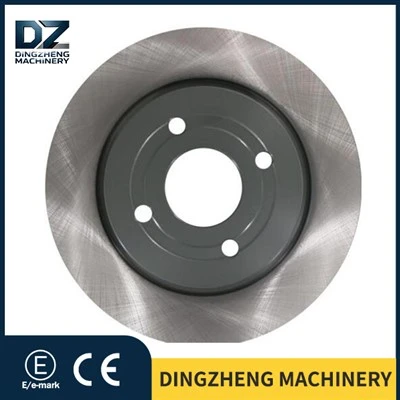

The automotive brake drum is a critical safety component in a drum braking system, with a direct impact on braking efficiency, operating stability and service life. To ensure reliable performance under different road and load conditions, manufacturers conduct comprehensive testing throughout the production process. Evaluating dimensional accuracy, material properties, mechanical performance and braking behavior helps identify potential defects and provides an important foundation for product quality and vehicle safety.
Dimensional accuracy is one of the key areas of brake drum inspection. Critical parameters such as inner and outer diameter, drum width, mounting-hole position and roundness of the braking surface are carefully measured. The geometry and dimensional accuracy of the inner braking surface are particularly important because they determine how evenly the brake shoes contact the drum. Significant deviations can contribute to uneven contact, vibration or abnormal wear during braking.
Material and mechanical testing are equally important. Brake drums are exposed to friction, high temperatures and repeated mechanical loads, requiring adequate strength, hardness and wear resistance. Manufacturers may use material composition analysis, hardness testing and other mechanical evaluations to verify material quality and confirm that the drum meets its specified design and performance requirements.
Braking performance testing evaluates how the brake drum behaves under representative operating conditions. Test procedures can simulate different vehicle speeds, brake pressures and load conditions to assess friction characteristics and changes in braking force. For vehicles exposed to frequent braking, testing also focuses on whether the drum can maintain consistent performance after repeated braking cycles.
Thermal performance is another important area of evaluation. Braking generates substantial heat, and excessive temperatures can contribute to reduced braking effectiveness or thermal deformation. Temperature-rise and thermal-cycle testing can therefore be used to evaluate heat dissipation, thermal stability and resistance to repeated thermal stress.
Brake drums may also undergo inspections for surface defects, cracks, dimensional irregularities and dynamic balance. Advanced manufacturing facilities increasingly use precision measurement equipment and automated inspection systems to monitor critical parameters throughout production. Digital quality records and traceability systems can further improve process control and product consistency.
As automotive manufacturing technology continues to advance, brake drum testing is becoming increasingly automated, digitalized and precise. A comprehensive testing system not only helps manufacturers maintain consistent product quality but also provides valuable data for improving materials, structural design and manufacturing processes. Through rigorous performance evaluation, brake drums can deliver the reliability, stability and durability required by modern braking systems.